Apart from the complex
of immovable palace buildings, the Palace Museum houses over
1.5 million items or sets of relics. Over 8,000 of them are
designated as first-class relics. They fall into the following
categories: paintings, calligraphy, rubbings from tablets, inscriptions,
sculptures, copperwares, porcelain, textile or embroidery, jade
or stone wares, gold or silver wares, jewelry, lacquerworks,
enamel wares, carvings, miscellaneous handiworks, stationery,
daily appliances, clocks and instruments, imperial
seals and certificates of the conferring of titles, religious
relics, weapons carried by guards of honor, ancient books, and
foreign relics.
Key attractions: The Meridian Gate: This
is the main gate of the Forbidden City. It sits on the north-south
axis of the city. It was built in 1420, or the 18th year of
Emperor Yongle’s reign in the Ming Dynasty. It was the place
where imperial edictsor calendars were issued. The
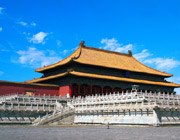
Hall of Great Harmony: This is the largest and most
prestigious building in the Forbidden City. It was built in
1420. It was here that 24 Ming and Qing emperors were crowned.
The turrets: These are located at the
four corners of the Forbidden City. They were built in 1420.
They are so architecturally complex that, as folklore has it,
each has 9 beams, 18 pillars, and 72 roof ridges. The
Hall of Heavenly Purity: This is the first of the three
halls of the inner court. It was first built in 1420. fourteen
emperors, from Zhudi to Zhu Youjian, had lived here.
The Hall of Military Prowess: This Hall was first built
in the early Ming Dynasty. It is located to the west of the
Xihe Gate of the outer court. Starting from the 40th year of
Emperor Kangxi’s reign, a great number of books and pictures
had been printed here. Known as ‘the Hall edition’, they are
highly valued for their exquisite, elegant workmanship. The Hall of Mental Cultivation:This Hall was
built during Emperor Jiajing’s reign in the Ming Dynasty. It
is located to the west of the Hall of Heavenly Purity in the
inner court. During the Qing Dynasty, eight emperors lived here.
It was also the place where the Empress Dowagers Cixi and Ci’an
“held court from behind a screen”.